Best Peptide Hair Growth Serum for Damaged Hair

Five peptide scalp serums lined up by formula, size and price position. The Ordinary leads, but three specific conditions flip the recommendation to something else.

By Jody ParkerUpdated 13 min read
On this page
- Best peptide hair growth serum for damaged hair at a glance
- How I narrowed the field to five
- What actually decides a peptide serum for damaged hair
- 1. The Ordinary Multi-Peptide Serum for Hair Density — Best overall
- 2. OGX ProGrowth + Peptide Scalp Serum — Best budget pick
- 3. INFINA ESSENTIALS Multi Peptide Hair Serum — Most versatile
- 4. Sahha GHK-Cu Peptide Hair Growth Serum — Best for families
- 5. Fléur Bloom Clinically Proven Copper GHK-CU Peptide Hair Serum — Best premium
- Can a peptide serum repair already-damaged hair?
- How long does a 2 fl oz bottle really last?
- What the listings do not tell you
- The verdict
- FAQ
The best peptide hair growth serum for damaged hair is The Ordinary Multi-Peptide Serum for Hair Density, a 2.02 fl oz leave-in that pairs six named peptide and caffeine technologies with plant extracts in an alcohol-free, silicone-free base. The misconception is that any peptide will do; what actually splits this field is how many peptides a formula stacks and whether the base leaves residue on already-fragile strands. If you want a single-ingredient copper peptide hero instead, Sahha's GHK-Cu serum is the better buy.
Best peptide hair growth serum for damaged hair at a glance
| Pick | Size | Peptide focus | Price |
|---|---|---|---|
Best overall The Ordinary Multi-Peptide Serum |
2.02 fl oz | Six technologies incl. REDENSYL, Procapil, CAPIXYL | Check Price |
Best budget pick OGX ProGrowth + Peptide Scalp Serum |
0.33 fl oz | Peptide + caffeine + micro-algae blend | Check Price |
Most versatile INFINA ESSENTIALS Multi Peptide Serum |
2 fl oz | Five peptides incl. GHK-Cu, Biotinoyl Tripeptide-1 | Check Price |
Best for families Sahha GHK-Cu Peptide Serum |
2 fl oz | 7200MG liposomal GHK-Cu (single hero) | Check Price |
Best premium Fléur Bloom Copper GHK-CU Serum |
1 fl oz | GHK-Cu plus five advanced peptides | Check Price |



How I narrowed the field to five
Three named reasons cut most of the candidate list before it reached this table.
- No peptide named on the label. Serums built on rosemary oil or castor oil with "peptide" only in the marketing were dropped. Every survivor names at least one peptide in its ingredient story.
- Heavy oil bases. Damaged hair does not need another film. Anything anchored on castor oil or thick silicone carriers was cut, which is why the five here all describe themselves as water-based or fast-absorbing leave-ins.
- No published size. A serum without a bottle size makes cost-per-use impossible to reason about, so unclear listings were removed.
What survived splits cleanly into two camps: multi-peptide stacks (The Ordinary, INFINA, Fléur) and copper-peptide-forward formulas (Sahha, and Fléur again with a GHK-Cu emphasis). OGX sits in a third camp: a small click-pen applicator built for targeted scalp use rather than full-head coverage. That structural difference is why it wins the budget slot rather than losing on volume alone.
A note on the search itself: Amazon returned these on a damaged-hair query, but none of the listings publish a claim that they repair fibre damage. Read them as scalp and density serums, and pair them with a separate bond-repair treatment on the lengths if your ends are the problem.
What actually decides a peptide serum for damaged hair
Most guides compare peptide names as if longer lists win. That is not what decides it. Two things decide it.
- How the serum sits on the scalp. Damaged hair usually means fragile strands and, often, a scalp that has already been through bleach, heat or tight styling. A residue-free water-based leave-in is the safer default. Four of the five picks describe themselves in exactly those terms; only Sahha uses a liposomal system as its main delivery story.
- How much product you can afford to use daily. Peptide serums are once-a-day treatments, and every listing here says so. A 0.33 fl oz applicator and a 2.02 fl oz dropper are different products in practice, regardless of headline ingredients.
Peptide count is a tiebreaker, not the main event. The Ordinary lists six named technologies. INFINA and Fléur list five peptides each. Sahha builds around one, at a stated 7200MG concentration. OGX names a single peptide inside its Long7vity Complex. If you already know one peptide works for you, a single-hero formula makes sense. If you are guessing, a stack hedges the bet.
1. The Ordinary Multi-Peptide Serum for Hair Density — Best overall
The widest peptide stack in this set, in a residue-free base sized for months of daily use.
Best for: someone who wants the widest peptide stack in one bottle Skip it if: you specifically want a copper peptide as the hero ingredient
The Ordinary names six technologies on the label: REDENSYL, Procapil, CAPIXYL, BAICAPIL, AnaGain, and High-Solubility Caffeine. Of the five picks here, that is the longest stack, and it sits in a 2.02 fl oz bottle, the largest published size in the set. The brand also states the formula is alcohol-free and silicone-free, both of which matter more than usual when the hair you are treating is already porous or chemically processed. Plant extracts named on the listing include Larix Europaea Wood Extract, Pisum Sativum Extract, and Camellia Sinensis Leaf Extract.
Application is once a day, a few drops on a clean, dry scalp, preferably at bedtime. That is standard across every pick here, which makes the size the practical differentiator: a bigger bottle at once-daily use means fewer reorders.
The trade-off is single-ingredient conviction. If your dermatologist told you to try copper peptides specifically, this is not the right vehicle: GHK-Cu is not the hero here. It is the widest bet in the set, not the deepest.
Pros:
- Six named peptide and caffeine technologies
- Largest bottle in this set at 2.02 fl oz
- Alcohol-free, silicone-free, vegan base
- The one buyers choose most often here
- Clear published dimensions and weight
Cons:
- No single hero peptide for targeted needs
- Only two sellers list it
- Bedtime-only guidance limits daytime routines
2. OGX ProGrowth + Peptide Scalp Serum — Best budget pick
A click-pen applicator built for targeted scalp zones rather than full coverage.

Best for: a first-time peptide user testing tolerance before committing Skip it if: you have a lot of scalp to cover or long-part-line thinning
OGX is the cheapest of the five and the smallest, at 0.33 fl oz. The applicator is a click pen, and the brand tells you to use it on the "Scalp T-Zone": temples, part, and front hairline. That is the honest way to read this product. It is a targeted treatment for the areas most people notice first, not a scalp-wide serum you rub through the whole head.
The Long7vity Complex named on the listing includes peptide, caffeine and micro-algae for the roots, plus niacinamide, feverfew, vitamin B5 and mango extract for the scalp. The base is described as free of fragrance, parabens, sulfated surfactants and alcohol, which is a useful profile if damaged hair sits alongside a reactive scalp. It was released in 2025, the only pick here with a stated release year.
The trade-off is straightforward: at 0.33 fl oz against 2 fl oz elsewhere, this is not a value pick for full-head use. Buy it to try peptides at low commitment, or to top up a specific zone.
Pros:
- The cheapest of the five
- Click-pen applicator targets specific scalp zones
- Fragrance-free, paraben-free, alcohol-free base
- Named peptide plus caffeine and micro-algae
- 2025 release date on the listing
Cons:
- Smallest volume in the set at 0.33 fl oz
- Not designed for full-scalp coverage
- Single peptide named rather than a stack
3. INFINA ESSENTIALS Multi Peptide Hair Serum — Most versatile
A five-peptide water-based leave-in that behaves well on colour-treated and fine hair.

Best for: colour-treated hair that reacts badly to silicones and heavy oils Skip it if: you want a single hero peptide rather than a five-peptide blend
INFINA names five peptides on the listing: Biotinoyl Tripeptide-1, Acetyl Tetrapeptide-3, Copper Tripeptide-1 (GHK-Cu), Myristoyl Hexapeptide-16, and a fifth in the same class. That is one of the deeper stacks in the set, and unusually, it includes GHK-Cu alongside the growth-signal peptides, which is why it earns the versatile label. You get the multi-peptide breadth of a stack with the copper peptide most often singled out in scalp research.
The base is water-based, silicone-free, sulfate-free and paraben-free, with rosemary leaf extract, apigenin, oleanolic acid, zinc chloride and glycerin as supporting ingredients. Application is a few drops at bedtime on a clean, dry scalp, left overnight, no rinse. The listing specifically calls out suitability for colour-treated hair, which matters when chemical processing is part of why the hair is damaged in the first place.
Against the top pick, INFINA carries five peptides where The Ordinary carries six technologies, and it is priced at the entry tier here. The trade-off is a shorter track record on this specific listing than the category leader.
Pros:
- Five named peptides including GHK-Cu
- Entry-tier price position in this set
- Water-based, no rinse required
- Explicit colour-treated hair suitability
- Silicone-free, sulfate-free, paraben-free
Cons:
- Sells more slowly than the top pick here
- Only two sellers list it
- No published dimensions on the listing
4. Sahha GHK-Cu Peptide Hair Growth Serum — Best for families
A single-hero copper peptide serum in a large 2 fl oz bottle two people can share.
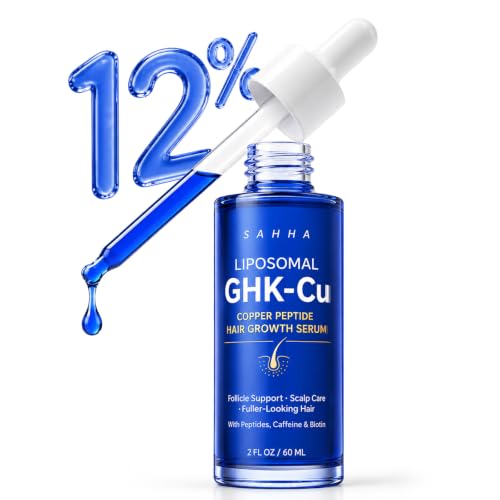
Best for: two people sharing one bottle and rotating application nights Skip it if: you dislike blue-tinted serums showing on a light pillowcase
Sahha bets on one peptide and bets hard: 7200MG of GHK-Cu in a liposomal complex, according to the brand. The liposomal delivery story is what separates it from every other formula here; the phospholipid encapsulation is supposed to protect the peptide as it reaches the scalp. Whether that translates to a better outcome for your hair is a question no listing here can answer, but the delivery approach is genuinely different, not a marketing repackage.
Beyond copper peptides, the formula names caffeine, biotin, panthenol and niacinamide as supporting ingredients. The listing highlights hairline, crown and part-line application. The bottle is 2 fl oz and blue, which is the visual quirk to know about: applied at bedtime, a blue-tinted serum can show on light bedding until it fully absorbs.
The family case comes from bottle size relative to a single-hero formula: two people applying a few drops to targeted zones stretch a 2 fl oz bottle further than one person applying it to a whole scalp. The trade-off is price position. Sahha sits at the top of the mid-to-premium band here for a formula built around one peptide, not a stack.
Pros:
- 7200MG stated GHK-Cu concentration
- Liposomal delivery system named
- 2 fl oz bottle supports shared use
- Caffeine, biotin, panthenol, niacinamide added
- Targeted application zones described
Cons:
- Premium price band for a single-peptide formula
- Blue tint may show on light pillowcases
- Sells more slowly than most of this set
5. Fléur Bloom Clinically Proven Copper GHK-CU Peptide Hair Serum — Best premium
A fragrance-free, paraben-free serum aimed at sensitive scalps, built on GHK-Cu plus five peptides.

Best for: sensitive scalps that flare from fragrance and parabens Skip it if: you want the largest bottle for the money in this set
Fléur pairs GHK-Cu with five additional peptides, according to the listing, and puts them in a 1 fl oz amber bottle. The formula is described as water-based, residue-free, paraben-free and fragrance-free, which is the exact profile a reactive or sensitised scalp usually needs. If you have already tried other serums and stopped because of scent or a tight feeling afterwards, that ingredient list matters more than the peptide count.
The application story is standard: daily use with a precision dropper, focused on roots and scalp, no rinse. Bottle dimensions are compact at 3.85 x 1.24 x 1.73 in, which is worth knowing if you travel with your scalp routine or share a bathroom shelf.
Fléur carries the highest price position of the five. What it buys is the sensitivity profile and a labelled peptide stack in one product. What it does not buy is volume: at 1 fl oz, it is half the size of the mid-set picks. The trade-off is real. If your scalp does not react to fragrance, a larger bottle at a lower price band probably makes more sense.
Pros:
- Fragrance-free and paraben-free formula
- GHK-Cu plus five named peptides
- Precision dropper for scalp-only application
- Compact travel-friendly dimensions
- Water-based, residue-free base
Cons:
- Highest price position in this set
- Smaller 1 fl oz bottle than most picks
- Only two sellers list it
Can a peptide serum repair already-damaged hair?
Can a peptide serum repair damaged hair the way a bond-builder does? Honestly, no. Every listing here talks about scalp support, hair density, and the appearance of thicker or fuller hair. None of them claim to rebuild broken disulfide bonds inside an existing strand. If your damage is from bleach, relaxers or heat and lives in the lengths, a peptide scalp serum is the wrong tool for that specific job. What it can do is help the new hair coming in.
How long does a 2 fl oz bottle really last?
A 2 fl oz bottle lasts as long as your application discipline lasts. Every pick here specifies once-daily use, a few drops on a clean, dry scalp. The Ordinary sits at 2.02 fl oz. INFINA and Sahha sit at 2 fl oz. Fléur is 1 fl oz. OGX is 0.33 fl oz. If you cover a whole scalp, larger bottles get you further; if you target a hairline or crown, the small applicator is not the handicap it looks.
Practical points worth planning around:
- Peptide serums are once-a-day products by design, not twice.
- Bedtime application is what four of five listings recommend.
- No pick here is a rinse-out treatment.
- Consistency matters more than dose. Skipping a week costs more than under-applying a night.
- A missed morning is not a reason to double up at night.
What the listings do not tell you
Three things you will not find in any product description here, and should know before you buy.
- Damaged hair repair happens on two fronts. Scalp serums address what grows next. Bond builders and protein masks address what is already on your head. Buying one and expecting the other is the most common disappointment in this category.
- Peptide serums need a runway. None of the listings promise week-one results, and the ones that mention timeframes point to consistent use over months. If you are shopping for a wedding in six weeks, adjust expectations.
- Interactions with other scalp products. Every pick here is a leave-in. If you already use a minoxidil, a prescription topical, or a strong exfoliating scalp acid, layering order matters and none of these listings tells you what to do about it. Ask a professional rather than guessing on the bathroom shelf.
The verdict
The Ordinary Multi-Peptide Serum for Hair Density is the default pick here. Six named technologies, a 2.02 fl oz bottle, an alcohol-free and silicone-free base, and the strongest sales position in the set add up to the widest bet a first-time buyer can make without overthinking the ingredient list. Two named conditions flip that recommendation.
If you specifically want copper peptides as the hero and you are willing to pay for concentration, Sahha's 7200MG GHK-Cu serum is the runner-up. Its advantage is single-ingredient conviction and a stated liposomal delivery system, neither of which The Ordinary tries to match. If you have a reactive scalp that has flared on fragranced products before, Fléur's Bloom serum is the safer buy: fragrance-free and paraben-free with GHK-Cu plus five peptides, at the smallest bottle size and the top of the price position here. Beyond that, INFINA is the best value on a full five-peptide stack, and OGX is the low-commitment way to test whether peptide serums work for you at all before spending on a larger bottle.
FAQ
Is a peptide serum worth it for damaged hair?
Is a peptide serum worth it depends on where your damage lives. For scalp health and the appearance of hair growing in, the ingredients named on these listings, peptides, caffeine, biotin, niacinamide, are aimed at exactly that. For fibre repair on hair already on your head, a peptide scalp serum is the wrong tool, and pairing one with a separate bond-repair treatment on the lengths makes more sense than expecting one product to do both.
What is the difference between The Ordinary and Sahha?
The difference between The Ordinary and Sahha is stack versus hero. The Ordinary names six technologies including REDENSYL, Procapil, CAPIXYL, BAICAPIL, AnaGain and caffeine, in a 2.02 fl oz alcohol-free, silicone-free base. Sahha builds around a single peptide, a stated 7200MG GHK-Cu liposomal complex, in a 2 fl oz bottle, with caffeine, biotin, panthenol and niacinamide supporting. Pick The Ordinary for breadth, Sahha for copper peptide conviction.
Does copper peptide GHK-Cu really help hair growth?
Does copper peptide GHK-Cu really help is the question every listing here dances around. Three of the five picks name GHK-Cu as an ingredient, and Sahha and Fléur build their identity on it. None of the listings publishes clinical data you can read from an Amazon page, so treat the ingredient as a specific bet worth trying if you like single-hero formulas, not as a guaranteed outcome above what a multi-peptide stack would deliver.
Can I use these serums on colour-treated hair?
Can I use these serums on colour-treated hair is the question INFINA answers most directly: its listing specifically calls out suitability for colour-treated hair. The Ordinary and Fléur name silicone-free, alcohol-free and fragrance-free bases that colour-treated hair generally tolerates well. All five apply to the scalp rather than the lengths, which limits pigment interaction anyway. If your colourist advised a specific waiting period after a service, follow that first.
Which peptide hair growth serum should I try first?
Which peptide hair growth serum should I try first depends on your budget and coverage. For a full scalp on a first attempt, The Ordinary's 2.02 fl oz bottle with six named technologies is the widest, safest bet. For a low-commitment test on a hairline or part, OGX's 0.33 fl oz click pen costs the least and targets exactly those zones. For a reactive scalp, start with Fléur's fragrance-free formula rather than gambling on a scented one.
Pick the bottle that matches the scalp area you actually plan to treat every night. That is what separates a serum that runs out in three weeks from one that lasts a season, and it is what separates a routine you keep from one you quit. If you are unsure, The Ordinary Multi-Peptide Serum for Hair Density is the version of this decision with the fewest ways to be wrong: a large bottle, a wide peptide stack, and a base that respects already-fragile hair. Start there, give it a full runway, and add a separate bond-repair treatment on the lengths if the damage you see is in the hair you already have.